You've got a deadline, a blank page, and a topic you half-care about. You write three sentences, delete them, write four more, delete those too. Forty minutes later the introduction is still not there and you're now "researching" by scrolling.
I know that loop intimately. The introduction is where most persuasive essays quietly die, and it has almost nothing to do with talent. It has to do with the fact that nobody ever taught you what an introduction is actually for. Teachers say "hook the reader" and "state your thesis" and you nod, and then you sit there with no idea how to turn that advice into sentences.
Here's the thing: an introduction is a small machine with three moving parts, and once you can see the machine, you can build one in ten minutes. I'll show you what each part does, what it looks like when it's broken, and how to fix it. I'll also be honest about the parts I got wrong for years.
Key takeaways
- A persuasive introduction does one job: it makes your reader unable to disagree without having read the rest.
- Three parts, in order: a hook that creates tension, context that earns the thesis, and a thesis that takes a real position.
- Target four to six sentences for a standard essay. Longer is usually fear, not thoroughness.
- Your thesis must be arguable. If someone can't reasonably disagree with it, it isn't a thesis.
- Write the introduction last, or at least rewrite it last. Always.
How to write a persuasive essay introduction: the three-part machine
Most guides hand you a list of hook types as if that's the whole puzzle. It isn't. The hook is only the first gear. Here's the full mechanism, and more importantly, what each gear is doing.
The hook makes a promise you have to keep
A hook is not a decoration. It's a promise: "keep reading and I'll resolve this." That's why a startling statistic works and a dictionary definition doesn't. "Since 1990, the number of... " creates an itch. "Webster's dictionary defines 'persuasion' as..." creates nothing except the urge to check your phone.
I spent months in my early teaching days convincing students to use statistics as hooks. Bad advice, in hindsight. A statistic only works if it's genuinely surprising to your specific reader. If you don't have a surprising number, use something else:
- A short scene: two sentences, one concrete image, no adjectives doing the heavy lifting.
- A blunt claim your reader will want to argue with.
- A question that exposes a gap in what most people assume.
- An admission: "I used to believe X. Then I read my own students' essays."
Pick one. Not all four. Three hook types stacked on top of each other reads like someone who didn't trust a single one.
Context is not summary
This is the part almost everyone gets wrong, including me for a long time. Students write two or three sentences summarizing the topic, as if the reader has never heard of recycling or social media or school uniforms. That's not context. That's a Wikipedia teaser.
Real context answers one question: why does this argument need to be made right now? What's the specific situation the reader is walking into? A school board vote. A shift in how a class is taught. A rule that changed and nobody adjusted to. Name the friction point and your reader leans in, because they recognize it.
If your context sentence could be pasted into any essay on the same general topic, cut it.
The thesis has to bleed a little
A thesis is not a topic. "School uniforms are a controversial issue" is a topic. "Mandatory uniforms reduce visible income gaps inside a classroom, which matters more than the comfort of students who'd rather wear their own clothes" is a thesis. It has a claim, it has a reason, and it steps on someone's toes.
Test yours with one question: could a reasonable person disagree with this in a single sentence? If the answer is no, rewrite it. If the answer is yes, good. You now have something to defend, and the rest of the essay writes itself because your body paragraphs exist to answer objections you already know are coming.
Before and after: fixing three real introductions
Abstract rules only stick when you see them applied. Here are three introductions I've actually seen, in the form they were submitted, with the rewrite I'd argue for.
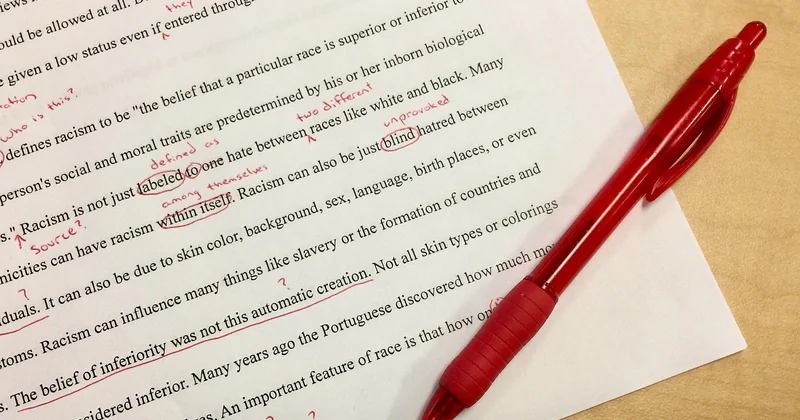
Example 1: the dictionary hook
Before: "According to the dictionary, 'homework' means work assigned to students to be completed outside of class. Homework has been a subject of debate for many years. In this essay I will discuss whether homework should be banned."
After: "Last spring my students spent an average of ninety minutes a night on assignments I could have finished in twenty. That gap is the real homework problem, and it isn't about whether homework exists. It's about whether it's designed by anyone who's thought about the student's whole day."
Notice what changed. The dictionary is gone. So is the announcement of what the essay will "discuss." The rewrite opens on a specific, small scene, then converts the scene into a stake. Two sentences, and the reader already knows the writer has a point of view.
Example 2: the fake thesis
Before: "Social media has changed the way teenagers communicate. There are positive and negative effects. This essay will explore both sides."
After: "Social media didn't change how teenagers communicate. It removed the part where they had to be bad at it in private first. Every awkward conversation now has an audience, and that's the part of the shift worth arguing about."
The original thesis is a weather report. The rewrite takes a position. It says something falsifiable, and it hands the reader the exact shape of the argument to come. And no, you don't need a three-part thesis with "first, second, and third" spelled out. In my experience that structure makes introductions read like table of contents.
Example 3: the essay about nothing
A student once handed me an introduction that opened with "Since the dawn of time, humans have needed to make decisions." I remember it because I wrote the exact same sentence as a first-year undergraduate. You can't beat that sentence in an argument. It's already lost.
What works instead is scale reduction: shrink from "since the dawn of time" to a specific Tuesday. A particular decision, a particular cost, a particular group of people affected. Specificity is the whole game.
How long should a persuasive essay introduction be?
Four to six sentences, in most cases. That's roughly 80 to 120 words for a standard essay. Shorter if the essay is short, slightly longer if the essay is a long-form argument.
| Essay length | Introduction (sentences) | Approximate words | What fits |
|---|---|---|---|
| 1–2 pages (school) | 4–5 | 70–100 | One scene, one line of context, one thesis |
| 3–5 pages (high school / first year) | 5–6 | 90–130 | Scene, context, thesis, one sentence naming the pay-off |
| 5+ pages (essay or paper) | 6–8 | 130–180 | Same, plus a brief note on why the argument is contested |
The number I use as a check is different: does your introduction take up more than ten percent of the whole essay? If yes, you've probably written a background paragraph pretending to be an introduction. Move the extra material into the body. It belongs there.
Why longer introductions usually fail
Because length in an introduction is almost always anxiety. You don't yet trust your own argument, so you circle it. I've graded hundreds of these and I can tell you the pattern holds: the longer the introduction, the vaguer the thesis, almost without exception. A confident position takes fewer words than a nervous one.
How the introduction locks the rest of the essay together
Here's the connection nobody explains clearly enough. Your thesis has two jobs in the body: it decides how many paragraphs you need, and it decides what order they go in.
Take a thesis with one main claim and one condition ("uniforms reduce income gaps, provided schools actually fund them for every family"). That thesis is now a two-paragraph obligation. Paragraph one: the gap argument. Paragraph two: the funding condition, and what happens when it's skipped. You don't need an outline. The thesis is the outline.
If you find yourself writing an introduction and then dreading the body, that's usually a sign your thesis is too vague. Vague thesis, foggy body. Specific thesis, obvious body. Fixing the introduction fixes the whole essay, which is why I rewrite mine after drafting, not before.
A checklist to run on your draft
- Read the first sentence out loud. Would a real person say it?
- Delete the first sentence. Does the paragraph still work? If yes, it wasn't a hook, it was a warm-up. Leave it deleted.
- Underline the thesis. Can you state the opposite in one sentence, seriously? If not, rewrite it.
- Count the sentences. Over seven? Cut or relocate.
- Does the last sentence of the introduction point clearly at the first body paragraph? If not, add the bridge.
The mistakes I made, and the one rule I wish I could pass on
My worst introduction had a hook, context, and a thesis. All three parts present, all three broken. The hook was a statistic I'd half-remembered and never checked. The context was three sentences of general background. The thesis was so broad it could have supported any essay on the same continent. My teacher wrote one comment in the margin — "You're not arguing, you're describing" — and it took two years for that note to actually land.
The rule I'd give you is simpler than any template: write the introduction you'd write if you only had one paragraph and no essay to follow it. Strip the padding, keep the sharpest thing you know about the topic, and put it first. If what's left doesn't make you slightly nervous to defend, you haven't gone far enough.
And if you write an introduction in one sitting and it feels finished, do me a favor: sleep on it. I've changed my mind about my own opening sentence roughly two times in three, and every single time, the second version was the one that held.